
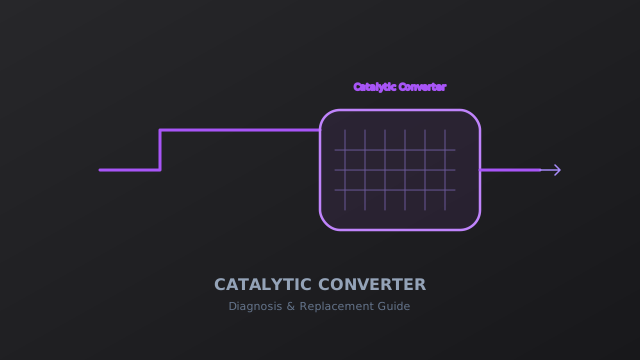
The catalytic converter is a vital emissions control component that converts harmful exhaust gases into less harmful substances before they leave the exhaust system. When it fails, your vehicle will not pass an emissions test, fuel economy will drop, and you may experience performance issues.
What Does a Catalytic Converter Do?
The catalytic converter uses precious metal catalysts (platinum, palladium, and rhodium) to facilitate three key chemical reactions:
- Oxidation of CO: 2CO + O₂ → 2CO₂
- Oxidation of HC: CₓHᵧ + (x+y/4)O₂ → xCO₂ + (y/2)H₂O
- Reduction of NOx: 2NO + 2CO → N₂ + 2CO₂
Common Symptoms of Catalytic Converter Failure
- Illuminated Check Engine Light — Stored codes typically include P0420 (Catalyst System Efficiency Below Threshold, Bank 1) or P0430 (Bank 2).
- Failed Emissions Test — Excessive HC, CO, or NOx readings indicate the catalyst is not converting effectively.
- Rattling Noise from Underbody — A dislodged or broken substrate (monolith) will rattle when the vehicle is driven.
- Sulphur or Rotten Egg Smell — Indicates a rich fuel mixture causing sulphur compounds to pass through the catalyst unburned.
- Reduced Fuel Economy — A clogged converter increases exhaust back-pressure, forcing the engine to work harder.
- Poor Acceleration — Excessive back-pressure from a blocked converter reduces engine power output noticeably.
Diagnostic Techniques
1. OBD-II Scan
Read stored trouble codes and monitoring readiness monitors. P0420 or P0430 directly indicate catalyst efficiency problems. Also check oxygen sensor data — a properly functioning catalyst should show significantly reduced signal oscillation at the post-cat O₂ sensor compared to the pre-cat sensor.
2. Temperature Test
Using an infrared thermometer or thermocouple, measure the temperature at the inlet and outlet of the catalytic converter at idle and at 2,000 RPM. Under normal operation, the outlet temperature should be 50–100°C higher than the inlet at idle and 100–200°C higher at 2,000 RPM. A smaller temperature differential indicates reduced catalytic activity.
3. Back-Pressure Test
Remove the upstream oxygen sensor and connect a pressure gauge. At idle, back-pressure should be below 1.25 psi (8.6 kPa). At 2,500 RPM, it should not exceed 3 psi (20.7 kPa). Higher readings indicate a clogged converter or exhaust restriction.
4. Visual Inspection
Look for physical damage, dents, or signs of overheating (discolouration or melted substrate visible through the oxygen sensor port). A collapsed or melted substrate requires immediate replacement.
Replacement Options
OEM Catalytic Converters — Manufactured to original specifications with precise precious metal loading. Full emissions compliance guaranteed. Higher cost but maximum reliability.
Aftermarket Direct-Fit Converters — Designed to match OEM specifications at a lower price point. Ensure the converter is CARB-approved or TÜV-certified for road use in your region.
Universal Catalytic Converters — Require welding into the existing exhaust system. More affordable but requires skilled installation. Check local regulations — some jurisdictions restrict universal converter use.
Preventing Converter Failure
- Address engine misfires immediately — unburned fuel destroys the catalyst
- Fix oil or coolant leaks — contamination coats the catalyst surface
- Replace worn oxygen sensors — faulty readings cause improper fuel mixture
- Avoid repeated short trips — the converter needs to reach operating temperature (400–600°C) to function
- Use quality fuel — low-grade fuel contains contaminates that accelerate catalyst degradation
At NOXWX, we stock a comprehensive range of OEM and high-quality aftermarket catalytic converters for European vehicles. Contact our technical team for advice on the correct replacement for your vehicle.